
Forgiveness reduces stress and worry and helps people move out of isolation and depression.
Can forgiveness really help with depression? Yes — learning to forgive interrupts the very thought patterns, the rumination and self-blame, that keep depression’s grip so tight, and it works alongside whatever other support you’re already getting.
Depression can feel like a heavy fog that settles over everything, so that even the good things in your life become harder to feel. If you are dealing with it right now, you already know how draining it is — how it saps the energy you need just to get through an ordinary day. It is one of the loneliest states a person can be in, because it can make you feel cut off even from people standing right next to you.
Like many people, I have had my own times of anxiety, panic and depression, and I know how convincing that fog can feel from the inside. For a long time, I assumed my low moods were simply happening to me — bad luck, difficult circumstances, other people not treating me the way I felt I deserved. It took me a while to notice something less comfortable: that my own judgmental, overly critical attitude toward myself and other people wasn’t a side effect of feeling low. It was helping to cause it.
Being judgmental and overly critical wasn’t a side effect of my low moods — it was helping to cause them.
That was uncomfortable to admit, because judgment can disguise itself as protection — it feels like it’s keeping you safe from being let down again. But being alone with a stream of critical thoughts, about yourself or everyone around you, is a recipe for misery, not safety. The more I judged people, the more isolated I felt, and the worse my mood became.
Part of what keeps depression going is how habitual our thinking becomes. When you spend enough time rehearsing worrying or hopeless thoughts, your body starts treating that as the normal state to be in — flooding itself with the kind of hormones that make you feel sluggish, cut off, and short of any real enthusiasm for life. You stop noticing the good things not because they’ve disappeared, but because your attention has been trained to search for what’s wrong instead.
The only difference between a painful lonely feeling and a pleasant feeling of solitude are the thoughts we think about ourself.
This is exactly where forgiveness earns its place in the conversation, not as a nice idea tacked onto the end of a self-help list, but as something that interrupts the habitual thinking underneath the fog. Forgiveness is the practical work of releasing the grudges, the self-blame, and the judgments we’re carrying — toward others and toward ourselves. When we’re depressed, blame is often close at hand: blaming someone for not visiting enough, blaming ourselves for not coping better, blaming the world for being unfair. Blame feels justified in the moment, but it only isolates us further from the very people we most want close to us.
The way out isn’t to force yourself to feel grateful or positive on command — that rarely works and can leave you feeling worse for failing at it. It’s to deliberately cultivate the feelings that create closeness instead: friendliness, empathy, and compassion, starting with yourself. Those qualities draw people toward us; cynicism and constant criticism push them away, exactly when we need connection the most.
A critical, cynical attitude isn’t just a symptom of depression to be managed alongside it — it’s frequently part of what’s driving it.
I found real help, at one stage, in Dorothy Rowe’s book on depression, which put into words something I badly needed to hear: a critical, cynical attitude isn’t just a symptom of depression to be managed alongside it — it’s frequently part of what’s driving it.
None of this replaces getting proper help. If you’re dealing with depression, please do talk to a doctor or a qualified professional — that’s consistently what helps people the most, and there’s no medal for struggling through it alone. Plenty of people who’ve openly struggled with depression have still gone on to live full, valuable lives. Forgiveness isn’t a replacement for that support; it’s something to practise alongside it, to loosen the grip of the thought patterns keeping you stuck.
If you’d like a simple, practical way to start, my ebook The Four Steps to Forgiveness is free to download — no email address needed — in PDF, Kindle or EPUB format. It won’t fix everything on its own, but it’s a real, workable place to begin loosening the fog, one small forgiveness at a time.
If You Have Your Doubts, Consider the Science
Perhaps all of this still sounds a little too neat to you — as if forgiveness is being offered as some cure-all for something as serious as depression. That’s a fair doubt to have, and you don’t have to take my word for it.
Large international studies, including research highlighted by the Templeton World Charity Foundation, have found that guided forgiveness practices measurably lower depression and anxiety across very different populations and cultures. This isn’t a fringe idea confined to one country or one type of person; it holds up wherever researchers have gone looking for it.
Research confirms that forgiveness leads to better mental health, lower blood pressure, and reduced anxiety.
Nor is it mysterious why this works. Forgiveness interrupts rumination — the endless mental replaying of old hurts that is one of depression’s most reliable fuels. Letting go of a grudge takes your body out of a constant fight-or-flight state, easing the flow of stress hormones like cortisol that keep you feeling wound up and worn out. Brain imaging studies go further still, showing that the act of choosing to forgive activates the areas of the brain responsible for empathy and emotional control, rather than the areas that keep feeding anger and threat.
None of that surprises me. It matches, almost exactly, what I have found simply by living it.
If the science is what convinces you, then let it be your reason to begin. You don’t need to take it on faith — simply try The Four Steps to Forgiveness for yourself, for free, and see whether your own mind and body respond the way the research says they should.
Download Free Ebook on How to Forgive
An unconditional gift to you from the Global Forgiveness Initiative (GFI).
The official GFI Four Steps to Forgiveness.
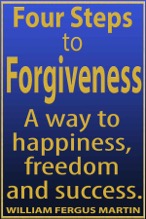
GFI Four Steps to Forgiveness. Immediate Download EPUB
GFI Four Steps to Forgiveness. Immediate Download PDF
GFI Four Steps to Forgiveness. Immediate Download KINDLE
A powerful way to freedom, happiness and success.
William Fergus Martin
ISBN: 978-1-63443-344-0